
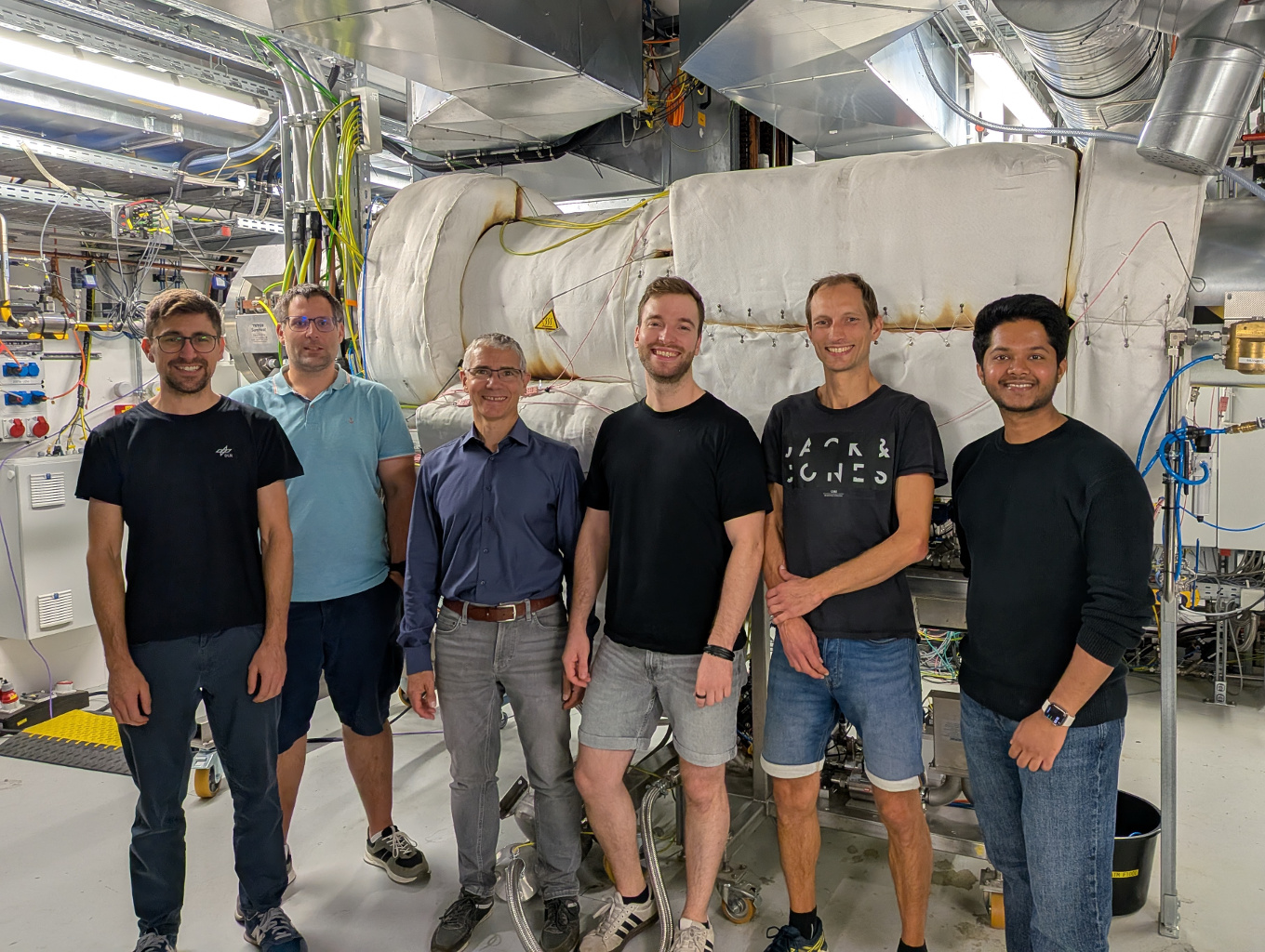
The MARPOWER project has reached an important milestone in the development of its fuel-flexible gas turbine-based energy conversion system for maritime transport. Researchers at the German Aerospace Center (DLR) have designed, manufactured, instrumented and commissioned the first MARPOWER combustion chamber prototype, successfully completing its first experimental tests with 100% hydrogen.
The combustion chamber is a key component of MARPOWER’s energy conversion system, as its design plays a central role in determining which fuels can be used to generate the high-temperature gases that drive the gas turbine. Its development is therefore closely linked to one of the project’s main technical objectives: building a gas turbine system capable of operating with different renewable and net-zero fuels. DLR is responsible for developing the combustion chamber as part of MARPOWER’s wider gas turbine development.
From baseline testing to the MARPOWER-specific design
Preparing for the experimental work required the DLR team from the Gas Turbines Department to set up a hydrogen supply line for its atmospheric combustor test rig in Stuttgart, equipping and instrumenting the facility for testing with hydrogen and natural gas. The test rig was subsequently commissioned and successfully operated with 100% hydrogen.
In spring 2026, DLR successfully completed baseline tests with 100% hydrogen using its existing F1000s reference combustor. These tests investigated the flexibility and performance of the baseline combustor in terms of combustion stability and exhaust gas emissions under different boundary conditions, including variations of air mass flow, inlet air temperature and fuel split.
The experimental test campaign, led by Sebastian Bellaire, provided the basis for the development of the first MARPOWER-specific combustion chamber and was combined with Computational Fluid Dynamics (CFD) simulations to develop the new design. Its main objectives were stable and clean hydrogen combustion and improved fuel flexibility.
The CFD work supported the parametric optimisation of the jet-stabilised combustor concept before moving to the physical prototype. This work was presented by Nikhil Shinde at the ASME Turbo Expo 2026 in Milan in the study “CFD-Based Parametric Design Optimization of a Fuel-Flexible Jet-Stabilized Combustor for Marine Gas Turbines”.
The resulting MARPOWER prototype incorporates an optimised nozzle geometry and an adapted combustor head. Following the design phase, the combustor was manufactured and instrumented before being experimentally tested in DLR’s atmospheric test rig with 100% hydrogen in summer 2026. The tests investigated its performance in terms of combustion stability and exhaust gas emissions under different operating conditions.
“Successfully completing the first hydrogen tests is an important step in the experimental development of the MARPOWER-specific combustor. We investigated its stability and emissions under different operating conditions and observed a wide and flashback-safe operational range combined with very low NOx emission levels. These findings confirmed the anticipated improvements resulting from the design optimisations. These experimental results, together with further simulations, are already feeding into the design of the second prototype, where we are focusing on further improving fuel flexibility, combustor efficiency, emissions and stability”, says Timo Lingstädt, from DLR’s Institute of Combustion Technology.
Fuel flexibility as a design requirement
While hydrogen is a central focus of the current design and testing activities, MARPOWER is developing a multi-fuel system designed to operate with different renewable and net-zero fuels, including hydrogen, ammonia, green methanol and green methane.
Fuel flexibility therefore needs to be addressed in the combustion chamber itself, where the different fuels are burned. DLR’s work aims to develop a combustion concept capable of accommodating the fuels considered by MARPOWER as part of the project’s gas turbine-based energy conversion system.
An iterative combustion chamber development process
The development programme includes two combustion chamber prototypes, combining numerical simulation with experimental testing. Work on the second MARPOWER prototype is already under way, using the experimental results from the first prototype together with further simulation results.
The second design focuses on fuel flexibility and combustor efficiency, as well as further improving hydrogen combustion in terms of emissions and stability. Design changes and fine-tuning, including further adaptations to the nozzle geometry, aim to enhance fuel flexibility and combustion performance.
Following its manufacture, the second prototype is expected to undergo experimental testing in 2027. DLR plans to investigate it under atmospheric conditions at its facilities in Stuttgart and assess pressure scalability in a high-pressure test rig. Testing under real gas turbine conditions is also planned using project partner Aurelia Turbines‘ A400 gas turbine in Lappeenranta, Finland.
As this iterative development continues, the experimental evidence generated through the testing of each prototype will help progressively refine the combustion concept, bringing MARPOWER closer to a fuel-flexible gas turbine-based energy conversion system designed to support the use of renewable and net-zero fuels and contribute to the decarbonisation of maritime transport.