
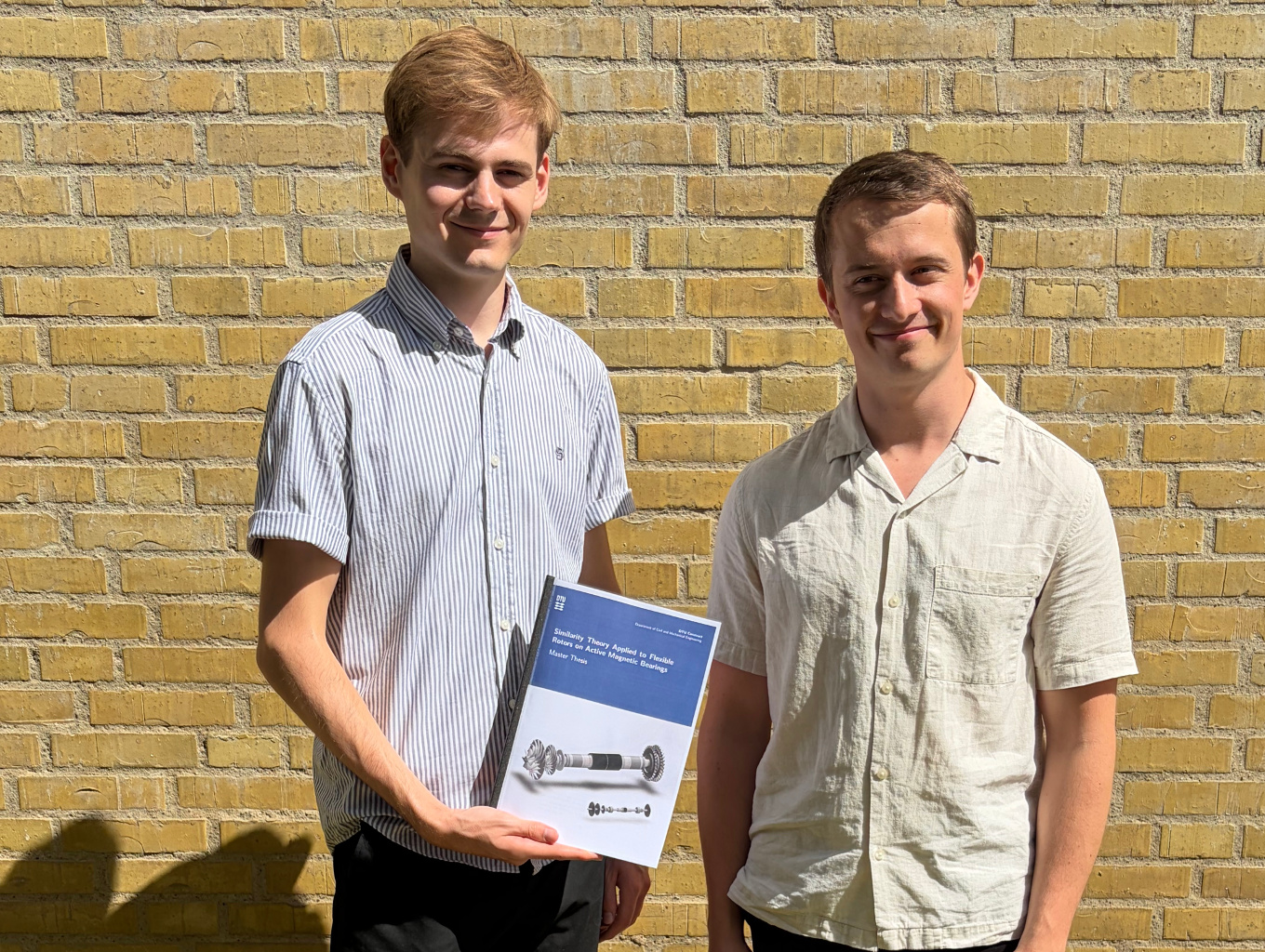
How can the behaviour of a large, high-speed turbine rotor be investigated in the laboratory without reproducing the entire system at full scale? This was the challenge addressed by Mikkel Gerner Jerlach and Thais Peter Bredal Jørgensen as part of research carried out within the MARPOWER project at the Technical University of Denmark (DTU). Their Master’s thesis, “Similarity Theory Applied to Flexible Rotors on Active Magnetic Bearings”, contributes to the project’s work on active magnetic bearings (AMBs) and rotor dynamics, which will ultimately include experimental investigations using a moving platform to reproduce the effects of ship motion.
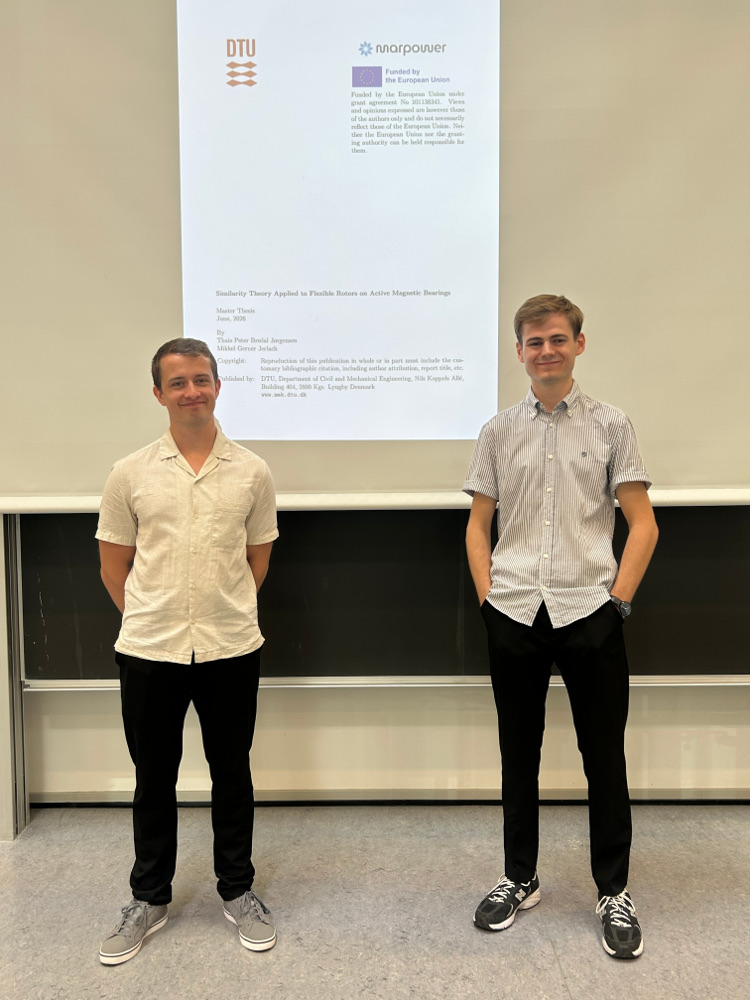
Supervised by Professor Ilmar Ferreira Santos, who leads the DTU team in MARPOWER, and researcher Bruno Rende, who works on multi-physics modelling and experimental testing of active magnetic bearing-supported rotors, Jerlach and Jørgensen successfully defended their thesis on 23 June 2026. The work focused on developing a dynamically representative reduced-scale model of the MARPOWER turbine rotor. The thesis is not currently publicly available, as its findings are being prepared for a scientific publication. Following the completion of their Master’s degrees, both graduates have also been recruited as Research Assistants at DTU for three months, from September to November 2026, allowing them to continue developing the research started during their thesis.
Bringing the MARPOWER rotor into the laboratory
Experimental validation is an important part of understanding the dynamic behaviour of MARPOWER’s rotor system, which comprises a 2.7 MW, 15,000 rpm gas turbine rotor supported by active magnetic bearings. Reproducing representative operating conditions at full scale, however, would require complex and costly testing facilities. The thesis therefore explored whether similarity theory could be used to create a smaller and more practical rotor that preserves the essential dynamic behaviour of the full-scale system.
Rather than simply reducing all the dimensions proportionally, Jerlach and Jørgensen investigated how the geometry, materials and other characteristics of the rotor could be adapted to maintain dynamic similarity. Their work began with a literature review of similarity theory and an assessment of three methods for establishing scaling laws. A benchmark model of the full-scale rotor assembly was then established using finite element analysis.
From this benchmark, the researchers developed a geometrically simplified full-scale model through optimisation, modifying its geometry and material selection while retaining its essential dynamic behaviour. Scaling laws were subsequently applied to produce a reduced-scale model, followed by further optimisation to improve manufacturability and minimise the discrepancies introduced by the scaling process.
From 576 kg to 25 kg
The resulting design reduces the rotor mass by almost 96%, from 576 kg to just 25 kg, while its longitudinal scale is reduced by approximately 53%. Despite this substantial reduction, the analysis showed that the model retains a very close correspondence with the key dynamic characteristics of the full-scale benchmark rotor.
For the first five pairs of vibration modes analysed, differences in natural frequencies and critical speeds were limited to between 0.1% and 2.2%. In practical terms, this means that although the reduced rotor is much lighter and smaller, the analysis indicates that it responds dynamically in a very similar way to the full-scale model in the characteristics examined.
These results demonstrate that a dynamically similar reduced-scale model can be developed with limited deviations from the benchmark model. By combining similarity theory with optimisation, the researchers were able to substantially reduce the rotor while accounting for practical manufacturing and experimental constraints. The design is intended to form the basis of a laboratory rotor that can subsequently be used to investigate rotor dynamics with active magnetic bearings on a hydraulically actuated moving platform simulating ship motion.
From a Master’s thesis to the next stage of MARPOWER research
Jerlach and Jørgensen first became involved with MARPOWER while looking for a Master’s thesis topic related to machine elements and rotor systems. During their initial discussions with Santos, they were introduced to the project and the preliminary research being conducted at DTU. The technical challenges involved immediately caught their attention and ultimately led them to focus their thesis on similarity theory and rotor scaling.
The work allowed them to bring together knowledge from across their Mechanical Engineering studies while also introducing them to new approaches and giving them their first extensive experience of academic research.
“The thesis gave us the opportunity to apply a very broad range of engineering knowledge acquired throughout our studies, from machine elements and structural dynamics to materials engineering and numerical methods. One of the most interesting things we learned was how numerical optimisation can be integrated into analytical engineering workflows to solve complex practical problems”, says Jørgensen.
Their work within MARPOWER will now continue during their three-month appointments as Research Assistants. Their next activities include preparing at least one scientific publication based on the thesis findings, producing detailed engineering drawings of the scaled rotor for manufacturing and supporting the development of the upcoming experimental setup.
Once manufactured, the scaled rotor is expected to support experimental investigations into rotor dynamics with active magnetic bearings and contribute to the validation of technologies relevant to the MARPOWER turbine concept. Future research activities are also expected to include investigations of backup bearing dynamics, where the similarity-analysis methodology developed during the thesis may also prove valuable.
“This was also our first extensive experience of academic research. Going through the investigation, analysis, writing and presentation of our findings developed our interest in scientific work and publication. Being able to dedicate ourselves fully to such a challenging engineering project also reinforced our confidence that engineering is the right career path for us”, says Jerlach.
Looking further ahead, both graduates expect to gain industrial experience after their current research appointments, while potentially returning to academia later in their careers.
DTU’s role in MARPOWER
As a MARPOWER partner, the Technical University of Denmark (DTU) contributes its expertise in rotor dynamics, active magnetic bearings and control systems, including the development of experimental approaches to study high-speed rotors under simulated ship motion.
Coordinated by LUT University, MARPOWER brings together 11 partners from six European countries to develop and validate a gas turbine-based energy conversion system for more sustainable maritime transport. Alongside DTU and LUT, the consortium includes Aurelia Technologies, Alfa Laval, Politecnico di Milano, the German Aerospace Center (DLR), the University of Vigo, RINA Consulting, RINA Services, Chantiers de l’Atlantique, and Zabala Innovation. Their complementary expertise supports the development of a fuel-flexible system designed to use sustainable alternatives such as hydrogen, ammonia, methane and methanol, helping reduce the maritime sector’s reliance on fossil fuels.