
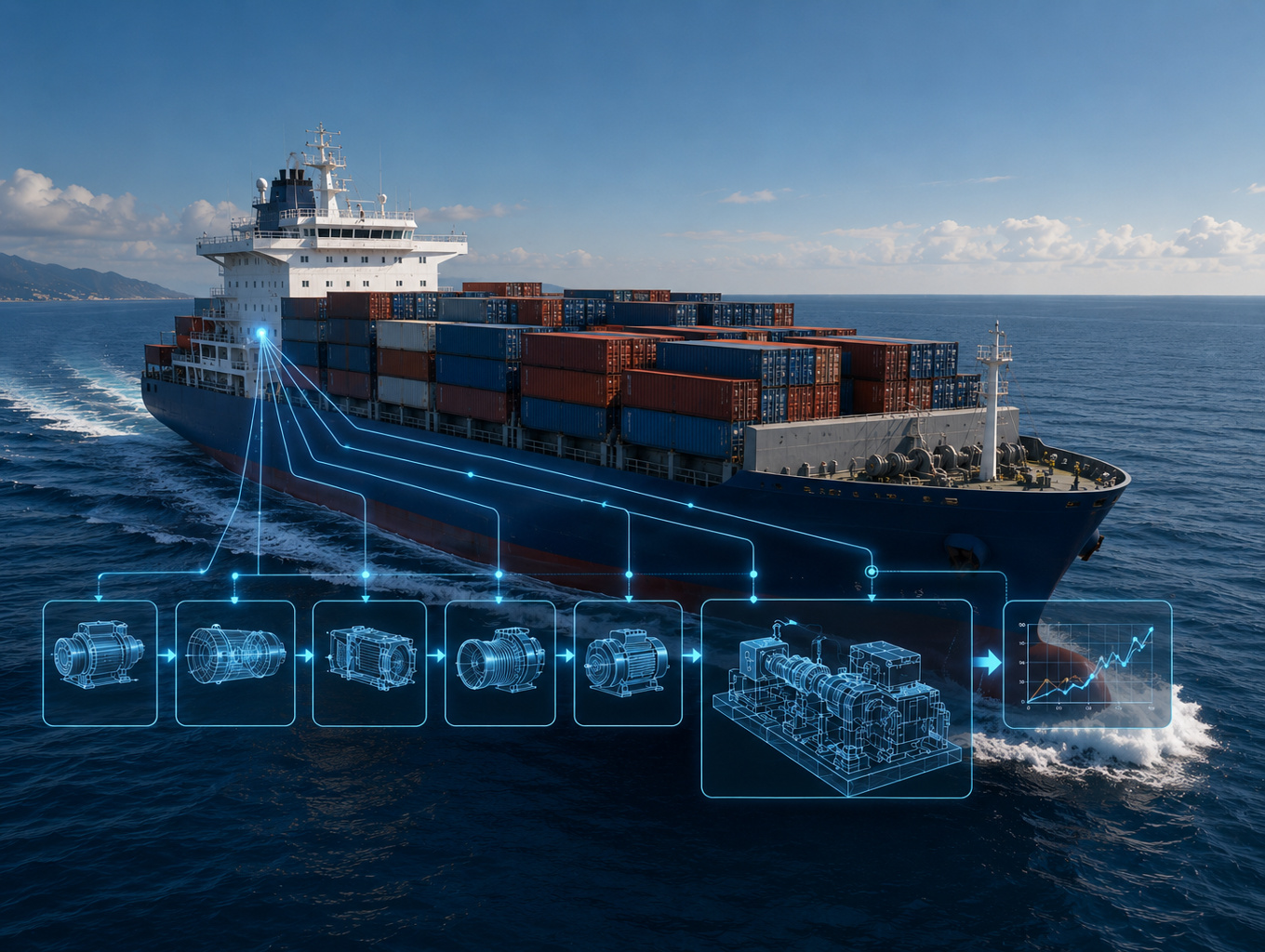
As MARPOWER develops its Energy Conversion System for onboard power generation in ships, one of the project’s key technical challenges is ensuring that complex component models developed by different partners can operate coherently within a unified simulation environment.
Components such as compressors, combustion chambers, recuperators, turbines and generators are developed using different modelling tools, datasets and engineering approaches. Integrating these elements into reliable maritime simulations requires a common framework capable of harmonising how technical information is structured, exchanged and interpreted across the consortium. This harmonised approach supports the broader digital validation environment developed within MARPOWER to simulate and analyse the behaviour of the complete Energy Conversion System under realistic maritime operating conditions.
This work is being led by the University of Vigo, with contributions from LUT University and the Technical University of Denmark (DTU), as part of MARPOWER’s broader digital validation activities supporting the development of its high-efficiency, fuel-flexible Energy Conversion System for maritime applications.
A common digital framework for integrated simulations
Advanced maritime energy systems depend on the interaction of multiple subsystems operating simultaneously under changing conditions. In MARPOWER, this includes components associated with compression, combustion, heat recovery, electrical generation and thermal management.

To support reliable integrated simulations, MARPOWER has already implemented harmonised procedures for structuring and integrating technical datasets associated with the system’s main components.
“Even highly advanced component models can become difficult to integrate if datasets are not harmonised”, explains Sergio Chapela, Associate Professor and Researcher at the University of Vigo. “Differences in units, parameter definitions or naming conventions may generate inconsistencies that affect simulation reliability and system validation”.
The framework established within MARPOWER helps ensure that data generated by different partners can be consistently interpreted and integrated into the project’s digital simulation environment.
Standardising component information across the consortium
A central element of this work is the implementation of standardised component datasheets already implemented within the project to support integrated simulations. These datasheets define how key technical parameters are described and organised for each subsystem within MARPOWER’s Energy Conversion System.
The approach covers both operational information and adjustable simulation parameters, enabling partners to maintain flexibility in their modelling activities while preserving overall consistency across the integrated environment.
According to the harmonisation framework developed within MARPOWER, these procedures help reduce complexity, avoid misinterpretation of parameters and facilitate automated integration into the simulation environment.
“The objective is not to restrict how partners develop their component models”, Chapela notes. “The objective is to ensure that all these models can interact coherently when integrated into simulations of the complete energy conversion system”.
This structured approach is particularly important in a project where multiple disciplines converge, including turbomachinery, combustion technologies, heat recovery systems, electrical generation and maritime integration.
Supporting reliable system-level analyses
The harmonisation activities implemented within MARPOWER are already supporting the development of reliable system-level simulations. By ensuring consistency across datasets and simulation inputs, the framework contributes to reducing integration errors and supporting more robust analyses of system behaviour under realistic maritime operating conditions.
This capability is particularly relevant when evaluating different load profiles, operational scenarios and alternative fuel conditions within MARPOWER’s Energy Conversion System.
The harmonised framework also supports future scalability assessments and optimisation studies, helping the consortium analyse how the system may perform across different operational contexts before future physical demonstration activities.
Building interoperable simulations for maritime energy systems
As maritime energy systems become increasingly integrated and fuel-flexible, interoperability between digital models is becoming a critical aspect of system development. MARPOWER’s harmonisation activities contribute to building simulation environments capable of supporting advanced engineering analyses while maintaining consistency across multiple technological domains.
These harmonisation activities reflect the collaborative nature of MARPOWER, where expertise in system modelling, combustion technologies, turbomachinery, ship integration and simulation is combined to support the development of next-generation onboard energy systems for ships. Partners including LUT University as project coordinator, Aurelia Technologies, Alfa Laval, Politecnico di Milano, RINA Consulting, RINA Services the University of Vigo, the German Aerospace Center (DLR), the Technical University of Denmark (DTU), Chantiers de l’Atlantique and Zabala Innovation contribute to the integrated development and validation of MARPOWER’s Energy Conversion System.
Further technical details are available in the project’s public deliverables section at https://marpowerproject.eu/results/.
AI-generated visual for illustrative purposes.