
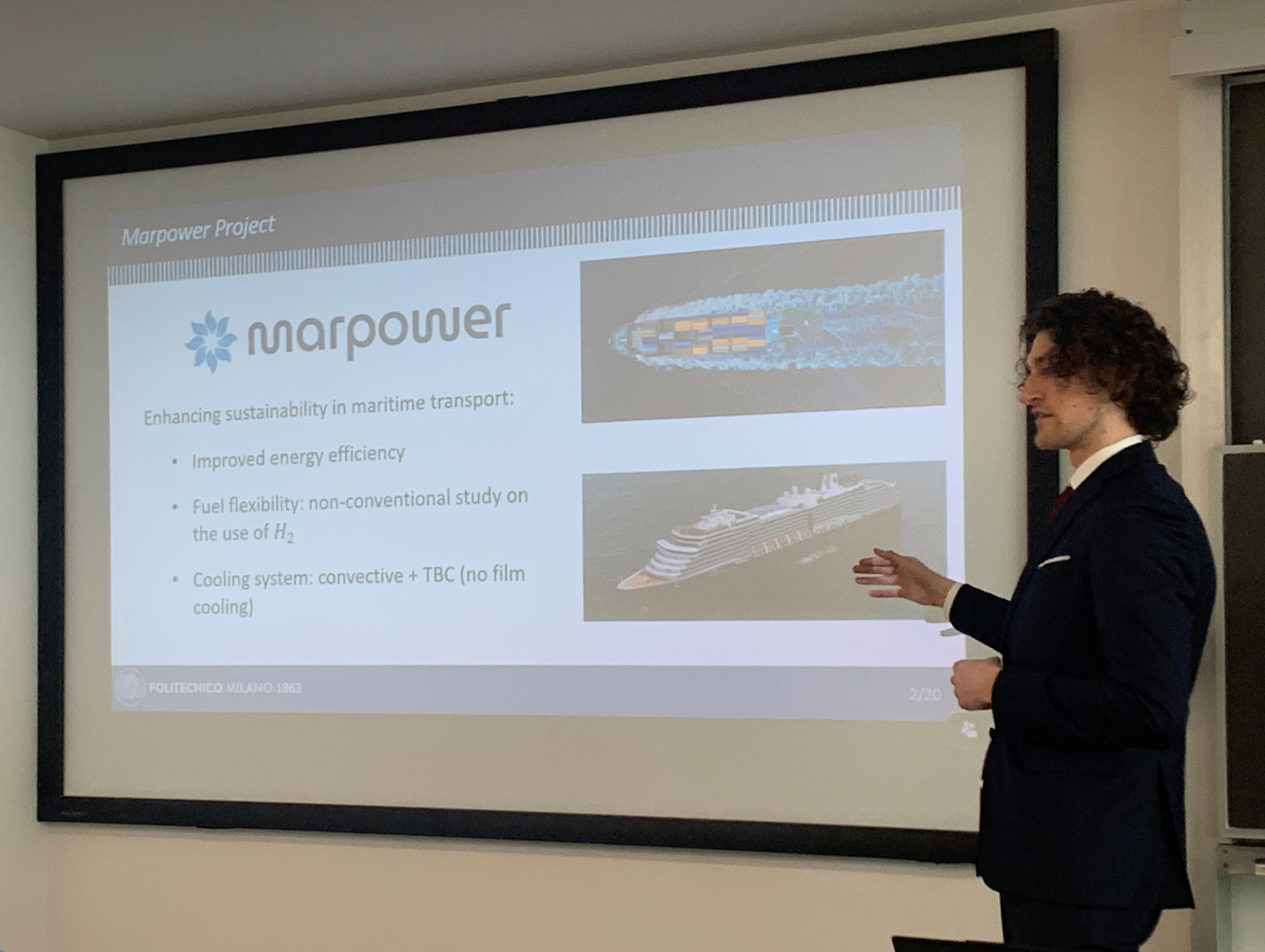
A recent Master’s thesis developed at Politecnico di Milano (POLIMI) contributes to the MARPOWER project’s research activities on advanced energy conversion systems for maritime transport.
The thesis, titled “Development of a thermal analysis model for cooled turbine blades”, was carried out by student Mattia Bonizzato under the supervision of Professor Giacomo Persico, Principal Investigator of POLIMI in MARPOWER, and PhD candidate Giuseppe Messina.
From academic training to applied research
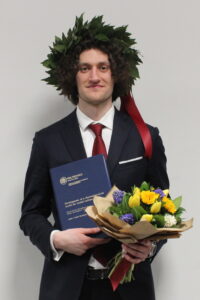
Mattia Bonizzato developed an early interest in mathematics and physics during his scientific high school education, which led him to pursue a Bachelor’s degree in Energy Engineering at Politecnico di Milano. After graduating in 2023, he continued with a Master’s degree in Power Generation, focusing on turbomachinery.
During this programme, he deepened his knowledge of thermodynamics, heat and mass transfer, and energy conversion systems, with particular attention to efficiency improvement. He also developed technical skills in numerical modelling and Computational Fluid Dynamics (CFD).
His thesis work is part of the broader research activities of the MARPOWER project, which aims to support the decarbonisation of maritime transport through the adoption of net-zero fuels.
Addressing cooling challenges in fuel-flexible gas turbines
Within MARPOWER, the advanced gas turbine system is designed to operate with a high degree of fuel flexibility, being capable of using a wide range of fuels, including hydrogen, renewable methane, methanol and ammonia.
However, the use of these fuels, together with strict emission constraints, limits the applicability of film-cooling techniques, requiring the design of non-conventional internal cooling systems.
In this context, the thesis focuses on the development of a thermal analysis model for cooled turbine blades, which are critical components in modern gas turbines. High-pressure turbine blades operate under extremely high temperatures, making effective cooling strategies essential to ensure both performance and structural integrity.
A computationally efficient thermal modelling approach
The developed model consists of a fully automated tool, called SLICE, capable of generating the 3D geometry of the cooling system and estimating the temperature distribution within the blade, enabling the evaluation of different cooling configurations in a computationally efficient way.
To reduce the computational cost, the method separates the three main heat conduction mechanisms acting in the problem:
- the blade conduction is solved using a Finite Element Method (FEM);
- a Robin boundary condition is used to model heat exchange between the blade surface and the hot gas flow, employing a priori obtained aerodynamic CFD data;
- a lumped element approach is applied to represent the coolant flow within the internal blade channels.
The blade metal temperature field is obtained through an iterative procedure between the FEM conduction analysis and the coolant network model until convergence is achieved.
Compared to high-fidelity conjugate heat transfer (CHT) simulations, the model is significantly less computationally demanding, making it particularly suitable for preliminary design phases. Validation against CHT results has demonstrated good accuracy and reliability, while the model tends to provide more conservative results.
The reduced computational time and effort required to estimate the blade thermal field represent the main advantage of the SLICE tool. This approach may also support future developments, including the implementation of optimisation algorithms to identify configurations that meet temperature constraints with minimal coolant usage.
Contribution to MARPOWER system development
The SLICE tool has been employed for the design of the cooling system for the first stator blade row of the high-pressure turbine within the MARPOWER system.
This contributes to the development of advanced gas turbine technologies for maritime applications, supporting the project’s overall objective of enabling more efficient energy conversion systems compatible with sustainable fuels.
The thesis also represented an important learning experience. As Mattia Bonizzato explains, “The thesis represented a significant learning experience for me, both from a technical and personal perspective. On the technical side, I strengthened my knowledge of heat transfer, numerical modelling, and turbine technology, while gaining hands-on experience in developing and validating engineering models”, while also developing problem-solving skills, perseverance, autonomy, and technical communication abilities.
Due to the presence of sensitive information related to the MARPOWER project, the full thesis is not publicly available.
Looking ahead
Following the completion of his Master’s degree in Energy Engineering, Mattia Bonizzato aims to continue working in the field of turbomachinery, contributing to the development of more efficient and sustainable energy systems, in line with the objectives of projects such as MARPOWER.