Expert insight: from data to digital twin in MARPOWER
Jacobo Porteiro and Sergio Chapela from the University of Vigo explain how MARPOWER is developing the digital foundations required to validate its Energy Conversion System under realistic maritime operating conditions
The maritime sector is facing increasing pressure to reduce greenhouse gas emissions while maintaining reliable and efficient operations across a wide range of vessel types and operating conditions. Achieving this transition requires not only the adoption of sustainable and net-zero fuels, but also the development of advanced energy systems capable of operating efficiently, safely and flexibly in real maritime environments.
Within this context, MARPOWER is developing a high-efficiency, fuel-flexible Energy Conversion System designed for onboard power generation in ships, based on a two-shaft gas turbine integrated with waste heat recovery. The system is being designed to support the decarbonisation of maritime transport by enabling operation with sustainable and net-zero fuels such as hydrogen, while maintaining compatibility with evolving environmental and safety standards.
To support the development and validation of this system, MARPOWER has established a dedicated digital framework capable of integrating physical and virtual data streams from the system’s main components. This work is being led by the University of Vigo, with contributions from partners LUT University and the Technical University of Denmark (DTU), and forms a key part of the project’s broader system validation activities.
Building the foundations of the digital twin
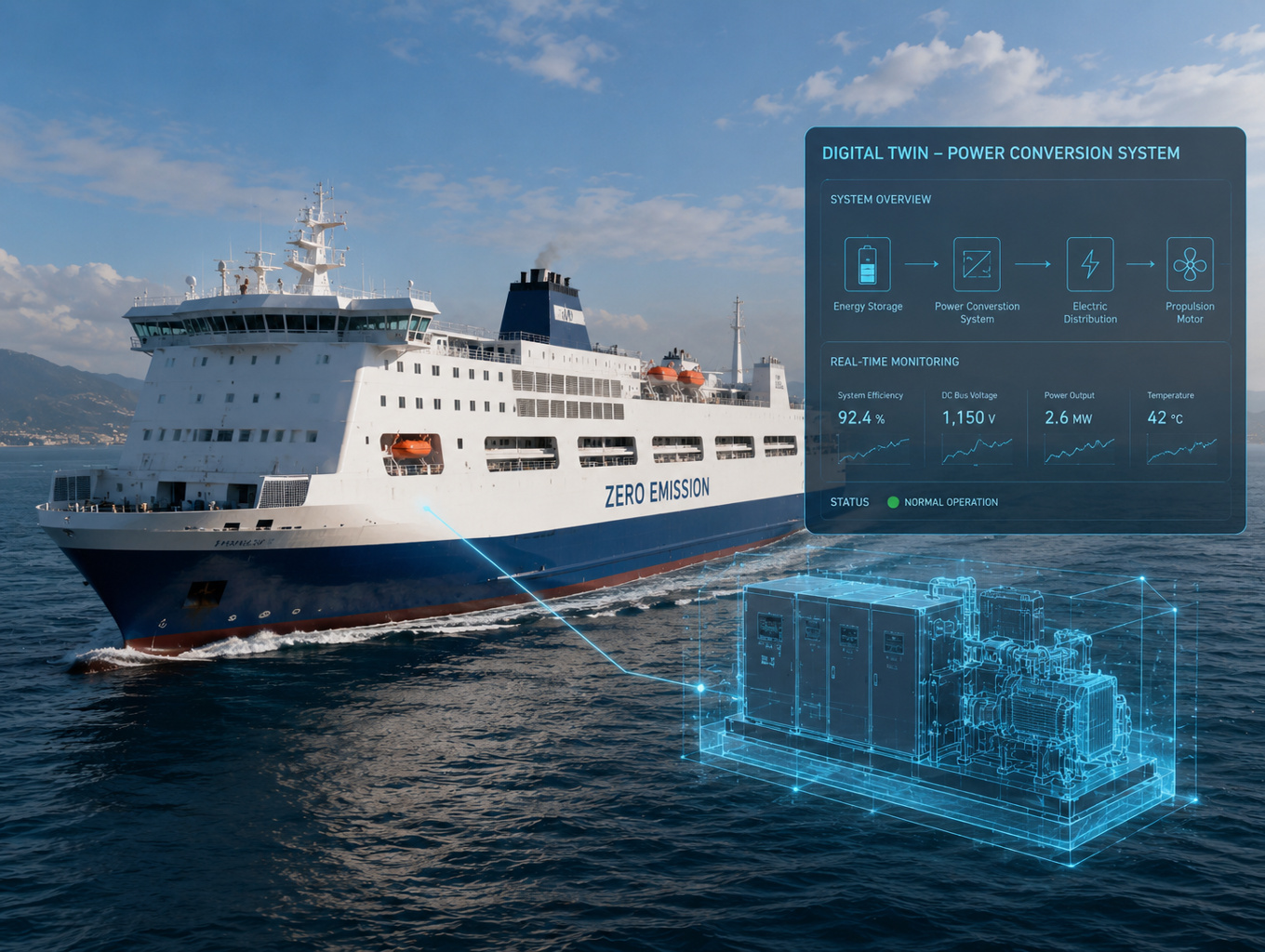
At the centre of this effort is the development of a digital twin environment for MARPOWER’s Energy Conversion System. The objective is not simply to create isolated component models, but to integrate data from compressors, combustion systems, recuperators, turbines, generators and other subsystems into a unified simulation framework capable of reproducing system behaviour under different operating conditions.
“The digital twin allows us to analyse how the complete system behaves as an integrated architecture rather than as a collection of independent components”, explains Jacobo Porteiro, Full Professor at the University of Vigo and Principal Investigator of MARPOWER at the institution. “This is essential when developing energy systems that must combine efficiency, fuel flexibility, operational resilience and safety within realistic maritime scenarios”.
The framework developed within MARPOWER is designed to integrate both physical datasets and virtual modelling outputs generated by different partners across the consortium. This coordinated approach supports the validation of system behaviour, operational performance and control strategies before future demonstration activities.
Simulating performance under realistic maritime conditions
One of the main advantages of the digital environment developed in MARPOWER is its ability to simulate how the Energy Conversion System may perform under varying operational conditions. This includes different power demands, changing load profiles and the use of different sustainable fuels.
According to the project’s validation objectives, the digital twin environment will support the assessment of scalability, efficiency, operational resilience and system safety. The framework is also intended to assist in the development of optimal control strategies capable of maximising system performance while responding dynamically to variations in ship power demand.
“In maritime applications, operating conditions are rarely constant”, notes Sergio Chapela, Associate Professor at the University of Vigo. “The value of the digital twin is that it allows us to evaluate how the system responds to changing scenarios and interactions between components before physical implementation”.
This capability is particularly important in the context of fuel flexibility. MARPOWER’s Energy Conversion System is being designed to operate with hydrogen while maintaining compatibility with other sustainable fuels such as green methane and green methanol. Simulating these operational conditions digitally helps the consortium evaluate performance trade-offs, integration challenges and future deployment scenarios.
Supporting system validation and future development
The digital framework developed within MARPOWER represents more than a theoretical methodology. It provides an operational environment already implemented within the project to support the development and validation of the Energy Conversion System.
By enabling the integration of physical and virtual datasets, the framework contributes to reducing technical uncertainty, improving system optimisation and supporting future scalability assessments before physical demonstration phases.